


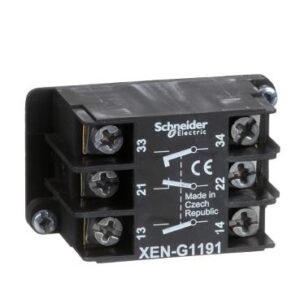


Contact Blocks

Original price was: 1.733,82 EGP.1.562,00 EGPCurrent price is: 1.562,00 EGP.
Comprehensive guide and physical architecture of Schneider Electric auxiliary monitoring contacts for two-speed systems: engineering coordinated dual-speed operation
Introduction to advanced monitoring systems and accessories for two-speed control and switching equipmentMotor and machine systems that operate at two speeds require precise signalling and immediate coordination between operating stages to protect equipment and maintain stable performance. Schneider Electricauxiliary monitoring contacts for two-speed systemsprovide an engineered means of transferring status signals and coordinating dual-speed control circuits, supporting smooth and stable operation inside electrical panels throughGahzly.
Engineering and physical architecture of auxiliary contacts for two-speed systems
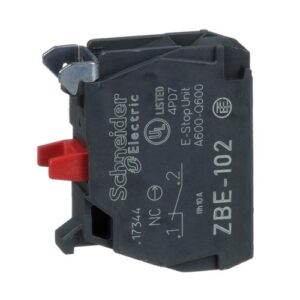
Compact, high-quality construction for stable transmission of multiple operating-status signalsThe enclosure usesSchneider Electric auxiliary monitoring contacts for two-speed systemsa rigid molded polymer body with additional internal depth for compatible control components and wiring.use a compact, high-quality construction designed to provide stable and reliable transmission of multiple operating-state signals and coordination between speed stagesfor associated equipment and systems inside electrical panels throughGahzly. The insulating, heat-resistant housing protects the precision contacts from environmental contamination and continuous mechanical vibration inside distribution and control panels.
Please sign in to submit a product report.
- Description
- Reviews
Description
Comprehensive guide and physical architecture of Schneider Electric auxiliary monitoring contacts for two-speed systems: engineering coordinated dual-speed operation
Multiple electrical contacts made from conductive alloys for low-loss signal transfer These units contain multiple electrical contacts made from conductive alloys designed for low-resistance signal transferwithin the installation.Gahzly, allowing low-voltage or low-current control signals to pass with minimal voltage drop and reduced interference, helping preserve signal integrity to logic controllers or indication circuits.Immediate response to state changes for accurate feedback to automation and indication systems They respond immediately to changes in operating position to provide accurate feedback to automation systems or local indication panels for the two speed stateswithin the installation.Gahzly, translating the mechanical contact position into electrical signals that indicate whether the equipment is operating at the first speed, second speed, or is fully stopped.
Operating mechanism and functional interaction of two-speed auxiliary contacts
The physical principle behind dual-speed coordination and signal transferTwo-speed auxiliary contacts operate mechanically and electrically in coordination with the movement of the associated breaker or control-switch mechanism. When the motor operating state changes between the first and second speed, the internal contact blades change position to open or close the corresponding signalling circuits. In a correctly designed control scheme, these auxiliary signals can be used for interlocking so that incompatible speed circuits are not energized simultaneously, helping protect dual-winding motors and related equipment.
Installation engineering and field wiring of auxiliary contacts
Mechanical mounting compatible with the main deviceInstallation starts by isolating the electrical supply and confirming absence of voltage. The auxiliary contact is then mounted in its designated position on the main breaker or switch, laterally or from above depending on the product design, and secured so that the mechanical operating linkage engages correctly.Connecting signal wires to the control circuitControl-circuit and indication-panel wires are connected to the accessory terminals and secured carefully to maintain a stable signal and prevent loose wiring inside electrical panels throughGahzly.
Technical specifications and functions table
Objective advantages and limitations
- Compact and robust constructionthat supports stable operation inside electrical panels throughGahzly.
- Contacts made from conductive alloysprovides low-loss signal transfer and smooth switching of status signals.
- Immediate responsesupports automation systems and provides highly accurate operating feedback.
- Safe coordination for switching between two speedsProtects equipment and motors from interlocking operating errors.
- Requires precision and skill during installation and mechanical interlocking with the main breaker.
- Designed specifically for two-speed applications, so its specialized capabilities are not fully utilized in simple single-speed applications.
Suitable and unsuitable applications
- Monitoring and coordinating the operation of two-speed motors in factories and ventilation systems through Gahzly.
- Linking indicator panels and monitoring displays to the field operating states of both speeds.
- Providing interlocking and safety signals for automated control systems (PLC).
- Not suitable for use as a main breaker for carrying high power loads, as it is intended only for control-signal transfer rather than power switching.
- Installation in circuits that do not require dual-speed systems, where this is a specialized advanced option.
Safe operation and installation method
- Complete Electrical Isolation: Completely isolate the electrical supply and verify absence of voltage before working inside electrical panels through Gahzly.
- Mechanical installation of the accessory: Fit the auxiliary contact in its designated position on the main device and make sure the operating levers engage correctly.
- Connecting signal wiring: Connect the monitoring and control-circuit wires accurately to the screw or quick-connect terminals.
- Testing and field verification: Operate the breaker and verify correct transfer of both speed signals inside electrical panels through Gahzly.
Important safety notice: Ensure the power is fully isolated before installing or removing control accessories to prevent accidental short circuits in low-voltage signal circuits.
Maintenance, cleaning, and extending service life
- Periodic visual inspection of wiring: Make sure signal wires remain securely tightened and free from corrosion or disconnection.
- Internal panel cleanliness: Keep the panel free of dust to prevent accumulation on precision contact points.
- Testing signal functions: Perform periodic tests to confirm that monitoring systems respond correctly when speeds are switched.
Important advice before purchase
- Verifying engineering compatibility: Confirm that the auxiliary-contact model is fully compatible with the breaker or main switch being used before purchase inside electrical panels through Gahzly.
- Determining signal requirements: Determine precisely how many normally open and normally closed contacts (NO/NC) are required for the two-speed control system before purchase inside electrical panels through Gahzly.
- Use Genuine, Traceable Products:Source the correct Schneider Electric breaker fromGahzly to ensure verified engineering quality and full compatibility.
Comprehensive conclusion
Schneider Electric auxiliary and monitoring contacts for two-speed systems are key components for organizing, coordinating, and monitoring two-speed motors and equipment safely and efficiently. Their compact construction, precision contact materials, and fast signal response support stable automation and reliable industrial control. Choosing the original product and sourcing it through Gahzly is an effective step toward improving the reliability and professional standard of electrical control panels.
Show only reviews in English (0)
Be the first to review “Contact Blocks”
You must be logged in to post a review.
Product Questions & Answers
No questions yet. Ask the supplier about specifications, compatibility, certifications or installation requirements.

Reviews
There are no reviews yet.