


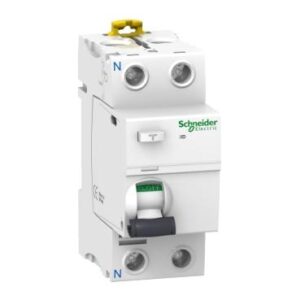
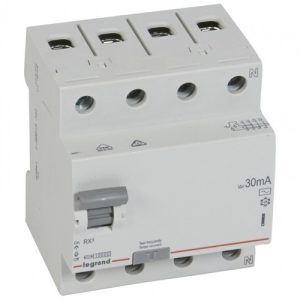
قاطع ثنائي حماية تسرب الأرضي أحادي سعة 25 أمبير 30 مللي أمبير – شنايدر إلكتريك

Price range: 5.459,10 EGP through 9.577,60 EGP
Comprehensive guide to the Schneider 30 mA residual-current circuit breaker: engineering architecture, life protection, and differential detection technologies
Introduction to Schneider’s earth-leakage protection system
In electrical-installation engineering and modern distribution-network design for homes and commercial facilities, protecting human life from electric shock is a fundamental requirement. Circuits directly accessible to users require highly sensitive protection capable of detecting very small leakage currents to earth. The engineering architecture of the Schneider Electric 30 mA residual-current protection breaker integrates a highly sensitive toroidal differential sensing coil that precisely measures current balance within the circuit. The breaker continuously monitors the phase current and compares it with the neutral return current. If a person touches a live conductor or faulty appliance, some current can flow through the body to earth. Once this leakage reaches 30 mA, the magnetic balance in the sensing coil is disturbed, immediately triggering the fast mechanical trip mechanism to disconnect power within a very short time and reduce the risk of dangerous cardiac effects on site through Gahzly.
Physical architecture and differential operating principle of the sensing coil
Toroidal Current Transformer
The physical architecture of this advanced breaker uses an internal magnetic ring through which the phase and neutral conductors pass in opposite directions. Under normal operating conditions, the current entering through the phase conductor is equal to the current returning through neutral, so the magnetic fluxes cancel and the trip mechanism receives no signal.
Magnetic imbalance and response at 30 mA leakage current
When leakage occurs because phase current reaches an improperly earthed metal body or a human body, a small immediate difference appears between outgoing and returning current. At 30 mA, this imbalance changes the magnetic flux in the toroidal core, causing the secondary winding to send an electrical pulse that activates the mechanical trip and disconnects power within fractions of a second, helping reduce potentially fatal effects on the human body and heart.
Periodic testing mechanisms and advanced insulated-body engineering
Mechanical test button (Test Button) and performance verification
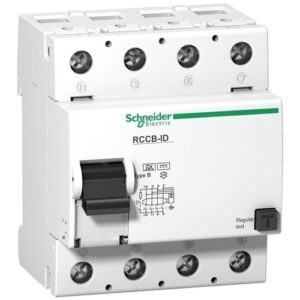
The breaker front includes a mechanical test button marked with the letter T (Test Button), intended for periodic verification of the response and movement of the internal mechanical parts and sensing coil. It allows the user or technician to safely simulate an earth-leakage condition and confirm that the breaker trips correctly. Periodic operation of this button is recommended to maintain confidence in protection performance.
Please sign in to submit a product report.
Technical specifications
A single structured view of reviewed Product Entry data and canonical WooCommerce specifications.
- Ampere
- 100A، 25A، 40A، 63A، 80A
- Brand
- Schneider Electric
- Description
- Reviews
Description
Comprehensive guide to the Schneider 30 mA residual-current circuit breaker: engineering architecture, life protection, and differential detection technologies.
High-density polymer housing with resistance to charring and combustion
The breaker outer housing is manufactured entirely from high-density polymer compounds resistant to charring and combustion and with self-extinguishing properties. This robust engineered enclosure protects the sensitive internal mechanism from external and environmental factors and helps prevent flame propagation or damage if the panel is exposed to sudden thermal stress.
Tunnel-terminal connection standards and field safety
Deep tunnel terminals and firm jaw clamping
The breaker includes deep tunnel terminals designed to clamp firmly onto copper conductors and prevent hot spots on site through Gahzly. These terminals accommodate different cable cross-sections with strong mechanical retention that reduces transition resistance and the risk of arcing caused by connections loosening over time.
Comprehensive protection against direct and indirect electric shock
A 30 mA sensitivity is a widely adopted level for personal protection against direct electric shock from touching live parts and indirect shock from touching conductive equipment enclosures made live by a fault, making it a primary protective measure in residential distribution boards and offices.
Technical specifications and functions table
| Technical specification | Primary function | Practical benefit to the user |
|---|---|---|
| 30 mA leakage sensitivity (30mA) | Detects small differences between phase and neutral current. | Protects human life and helps reduce the risk of dangerous cardiac muscle contraction during electric shock. |
| Precision toroidal differential sensing coil | Continuously compares current flow between conductors. | Provides rapid response to unintended leakage current. |
| Periodic Test button | Simulates a leakage condition to verify the trip mechanism. | Helps confirm breaker readiness and identify faults early. |
| High-density polymer housing | Protects internal components and resists combustion and charring. | Provides high structural safety and helps prevent flame spread inside the panel. |
| Deep tunnel terminals | Clamp strongly onto copper cables and help prevent overheating. | Stabilize the electrical connection and reduce the risks of arcing and looseness. |
Objective advantages and limitations
Key advantages:
High level of personal protection: 30 mA sensitivity provides strong protection against potentially fatal electric shock.
Fast trip response: disconnects power within fractions of a second after detecting leakage, reducing the risk of severe injury.
Reliable and easy testing: the test button enables simple periodic verification of operating performance.
Strong manufacturing durability: the flame-resistant polymer body supports long service life.
Limitations and objective disadvantages:
Potential nuisance tripping: repeated trips may occur where older poorly insulated appliances have small earth leakage or where moisture levels are high.
Does not replace thermal-magnetic circuit breakers: its primary function is earth-leakage detection and it does not substitute for conventional short-circuit and overcurrent protection unless it is an integrated device such as an RCBO.
Suitable and unsuitable applications
Ideal applications:
Residential and apartment sub-distribution boards protecting bedrooms, kitchens, and bathrooms.
Protection of circuits supplying appliances located near water sources, such as water heaters, washing machines, and water pumps.
Schools, hospitals, and commercial centers where public areas require strict electrical-safety standards.
Swimming pools and outdoor gardens to reduce leakage-current risks in humid environments.
Unsuitable applications:
Main industrial panels with naturally high leakage currents from large machinery, where higher residual-current thresholds such as 300 mA or 500 mA may be required.
Loads that generate normal operating leakage pulses and could cause nuisance tripping unless the appropriate breaker type, such as Type A or Type B, is selected.
Safe operation and installation method
Complete electrical isolation: switch off the panel main breaker and verify the absence of voltage with an approved test instrument before starting.
Mounting on the rail: securely install the residual-current breaker on the metal DIN Rail inside the distribution board.
Accurate conductor connection: connect the incoming and outgoing phase and neutral conductors to the designated terminals, taking care not to mix the protected neutral with neutrals from other circuits, and tighten the terminal screws to the specified torque.
Field inspection and testing: restore power and press the Test button to confirm that the breaker trips immediately, then reset it to verify readiness on site through Gahzly.
Important safety warning: never combine the neutral conductor protected by this breaker with other neutral conductors outside the protected circuit, as this can cause continuous false tripping.
Maintenance, cleaning, and extending service life
Regular periodic testing: press the Test button once a month or every three months, according to the applicable maintenance policy, to verify free movement of internal parts and prevent sticking.
Periodic terminal inspection: regularly confirm that screw terminals remain properly tightened to prevent looseness caused by thermal expansion and contraction.
Dry panel cleaning: keep the breaker area free from dust and moisture, using compressed air only with appropriate care and safe isolation.
Important advice before purchase
Select the sensitivity accurately: confirm that 30 mA sensitivity is required for personal protection, since other sensitivities such as 300 mA are generally intended for installation and fire protection rather than direct personal protection.
Match the current rating to the load: choose the appropriate current rating for the circuit, such as 25 A, 40 A, or 63 A, to avoid thermal overload of the device.
Buy genuine products: use an original approved Schneider residual-current breaker to ensure sensing accuracy and reliable availability through the Gahzly platform.
Comprehensive conclusion
The Schneider 30 mA residual-current breaker is a fundamental safety device for protecting people against unexpected electric-shock hazards in residential and commercial installations. With its high-precision toroidal differential sensing architecture, periodic test button, and flame-resistant housing, it provides rapid, safe response to leakage currents. Investing in an original product and sourcing it through the Gahzly platform is an important step toward improving long-term electrical and living safety for you and your family.
Show only reviews in English (0)
Be the first to review “قاطع ثنائي حماية تسرب الأرضي أحادي سعة 25 أمبير 30 مللي أمبير – شنايدر إلكتريك”
You must be logged in to post a review.
Product Questions & Answers
No questions yet. Ask the supplier about specifications, compatibility, certifications or installation requirements.

Reviews
There are no reviews yet.