sell online December 25, 2023 14 min read

Everything you need to know about amperes and measuring electrical voltage

Everything you need to know about amperes and measuring electrical voltage In the world of electrical engineers and electronic technicians, determining voltage and measuring current are considered basic steps in examining and diagnosing electrical circuits. Voltage represents the driving force for the…
Everything you need to know about amperes and measuring electrical voltage
Everything you need to know about amperes and measuring electrical voltage

Everything you need to know about amperes and measuring electrical voltage

In the world of electrical engineers and electronic technicians, determining voltage and measuring current are considered basic steps in examining and diagnosing electrical circuits. Voltage represents the driving force for the flow of current, while current shows the transport of electricity in a circuit. We’ll take a quick look at how to measure voltage and current to ensure safety and efficiency in an electrical system.
A basic understanding of how to measure voltage and current

Voltage and current measurements are considered among the basic elements in the field of electricity and electronics. Saving energy and checking electrical circuits requires a careful understanding of how to measure these two key factors. We will take an overview of both voltage and current and how they can be measured.

Electrical voltage:

Voltage is a force that drives the flow of current in an electrical circuit. Voltage is measured in volts (V), and refers to the electrical difference between two points in a circuit. To measure voltage, a device known as a voltmeter is used, and its electrodes are placed on the two points to be measured. a i=4>between them.

How to measure voltage:

  1. Set the potentiometer to volts.
  2. Connect the electrodes of the device to the two terminals between which you want to measure the voltage.
  3. The measurement reading appears on the voltmeter screen.

electric current:

Current is the flow of electrical charges in a circuit, and is measured in amperes (A). Current refers to the amount of electricity that passes through a specific point in a circuit per unit time. Current is measured using a device known as an ammeter, which is connected in the path of current flow.

How to measure current:

  1. Put the ammeter to the ampere position.
  2. Disconnect the circuit and connect an ammeter where current will flow through it.
  3. The measurement reading appears on the ammeter screen.

NB:

  • Voltage and current must be measured in insulated metal assemblies to avoid short circuits.
  • Before measuring the current, make sure the circuit is open and cut off the current to avoid damaging the ammeter.

Understanding the basics of measuring voltage and current is vital for anyone working in the electrical and electronics fields. These readings can provide a deeper understanding of how electrical energy travels in circuits and contribute to maintenance and fault diagnosis.

How to measure voltage and amperes

Multimeter: The basis for measuring electricity and electronics

The multimeter is a vital and necessary tool for every technician working in the fields of electricity, electronics, batteries, solar energy, and electrical control. This device is used to accurately measure and examine most electrical and electronic parts.

The multimeter is used for the following purposes:

  • Inspecting domestic and industrial electricity networks.
  • Measure source voltage and resistors.
  • Inspecting all electronic parts such as resistors, transistors, diodes, etc.

Multimeter sensors:

Multimeter probes allow the technician to accurately measure various electrical variables. They can be used to measure voltage, current, resistance, frequency, etc. Probes come with different connections to suit specific measurement requirements.

The difference between a manual and an automatic multimeter:

The multimeter is available in two main models: manual and automatic. Manual requires the user to manually select the appropriate measurement range, while automatic selects the correct application automatically. Automatic is preferred for beginners for ease of use, while manual is preferred for those who need precise control over the measurement processes.

In general, the multimeter is an indispensable partner for checking and measuring electricity and electronics, and it contributes to facilitating many technical operations in various fields.

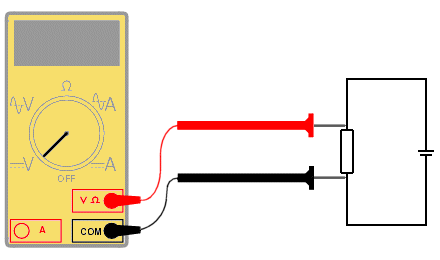
How to measure voltage using a multimeter:

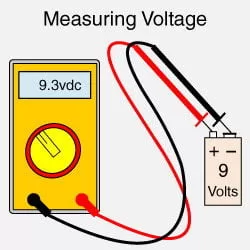
To measure direct voltage (DC):

  1. Place the device’s red probe into the voltage port (marked by the letter V).
  2. Place the black probe into the common (COM) port.
  3. Turn on the multimeter by pressing the power key or moving the cursor key.
  4. Place the cursor on the constant voltage symbol “Volt” (V).
  5. If you have a manual setting device, set the indicator to a voltage higher than the expected battery voltage.
  6. Place the device’s red probe on the positive (+) terminal of the battery, and the black probe on the negative (-) terminal.
  7. The reading will appear on the device’s screen, and if its value is close to the expected battery voltage, the battery is considered healthy.

To measure alternating voltage (AC):

  1. Place the red probe of the device into the voltage port (V).
  2. Place the black probe into the common (COM) port.
  3. Turn on the multimeter and place the scale knob on the AC voltage symbol “Volt” (V) Drawn next to it is a sine wave.
  4. Place the two multimeter probes (red and black) in parallel with the household electrical socket (vase and socket), without regard to polarity.
  5. The value will appear on the device screen, showing the source voltage in AC voltage.

These steps help in accurately measuring voltage and understanding the condition of electrical circuits.

Note: Make sure to cut off the power and disconnect the adapter from the electronic board before starting the scan.

  1. Check optics:
    • Visually inspect the adapter to ensure there are no obvious signs of wear or damage.
    • Make sure there are no leaks in the insulating or reflective material.
  2. Resistance test:
    • Use a resistance meter to measure the resistance across the main windings of the transformer.
    • Measure between the transformer outputs and make sure there is no short value.
  3. Windings test:
    • Measure the resistance across each transformer winding.
    • Check that the resistance is within the specification value.
  4. Voltage test:
    • Connect the adapter to a suitable voltage source.
    • Use a potentiometer to measure the voltage on the outputs.
    • Ensure that the output voltage matches the specified specifications of the transformer.
  5. Insulation test:
    • Check the insulation between the coils and between the coils and the external housing.
    • Make sure there is no low value of insulation.
  6. pregnancy test:
    • Connect a load (specific resistance) to the outputs and measure the voltage and current.
    • Make sure the transformer is able to provide the required current and voltage to the load.
  7. Temperature check:
    • Run the inverter for a long time and monitor the temperature.
    • Ensure that there is no unusual rise in temperature.

If any problem is detected during the inspection, it is best to replace the adapter with a new unit or service it as needed.

Step-down transformers: inspection and function

A step-down transformer is an essential part of electronic devices such as radios, televisions, and battery chargers. This type of transformer comes with several terminals, but we will examine the transformer with four terminals (two terminals for the primary coil and two terminals for the secondary coil).

the structure:

  • The transformer consists of two coils: a primary coil (input) and a secondary coil (output).
  • The primary coil has two terminals (the input), while the secondary coil has two terminals (the output).

Converter function:

  • The transformer reduces the voltage coming from the power source (such as 220VAC/110VAC) to a low value that is used to power electronic circuits.

Transformer check:

  1. Visual inspection:
    • Check for damage or leaks in the files.
    • Ensure the integrity of the external structure.
  2. Resistance test:
    • Use a resistance meter to measure resistance across the main windings.
    • Make sure there is no low resistance value.
  3. Voltage test:
    • Connect the adapter to a suitable voltage source.
    • Use a voltmeter to measure the voltage on the secondary coil.
    • Make sure the output voltage meets specifications.
  4. pregnancy test:
    • Connect a load (specific resistance) to the outputs and measure the voltage and current.
    • Make sure the transformer is able to provide the required current and voltage to the load.
  5. Temperature check:
    • Run the inverter for a long time and monitor the temperature.
    • Ensure that there is no unusual rise in temperature.

By continuing regular inspection and maintenance, you can maintain the performance of the transformer and ensure its effective operation in electronic devices.

Everything you need to know about amperes and measuring electrical voltage

Steps to inspect step-down transformers

Inspection of step-down transformers is vital to ensure their efficient and proper performance. The following steps can be followed to ensure the safety of the transformer:

  1. Disconnection:
    • Make sure to disconnect the adapter from the power source before starting the inspection.
    • If the adapter is connected to an electronic circuit, disconnect it as well.
  2. Resistance measurement:
    • Using a multimeter, measure the resistance of the primary and secondary coils.
    • The multimeter may be set to the appropriate resistance range, such as 1k or 200 ohms.
  3. Connecting sensors:
    • Place multimeter probes on both ends of the primary coil, regardless of polarity.
    • The multimeter reading will show a certain resistance value.
  4. Reading analysis:
    • Analyze the multimeter reading, where the value is expected to be within reasonable limits for the primary coil.
  5. Repeat the process for the secondary file:
    • Measure the resistance of the secondary coil using the same method.
    • The value of the secondary coil may be much lower than the primary coil.
  6. Analysis of the results:
    • If the winding values ​​(primary and secondary) are within normal limits and there are no excessive readings (such as infinite or zero reading), the transformer is working well.
  7. Insulation check:
    • Make sure there are no leaks or damage to the external insulation of the transformer.
    • Follow safety procedures when handling the adapter.

By following these steps, you can check the status of your adapter and ensure it continues to operate efficiently.

How to measure electric current (ampere) practically

Electric current, which is measured in amperes, is one of the basic elements in electrical circuits. You can measure electrical current practically using a multimeter. Here are the steps:

What is the ampere unit: The ampere unit is the unit of measurement for electric current, and is symbolized by the letter “A”. It is used to measure the amount of current flowing in an electrical circuit.

Steps to practically measure amperes using a multimeter:

  1. Connecting the multimeter:
    • Connect the red probe of the multimeter to the ampere meter.
    • Connect the black probe to the common (COM) slot.
  2. Determine the type of current:
    • Choose the appropriate ampere measurement mode on the multimeter, and choose between direct current (DC) or alternating current (AC) depending on the type of circuit.
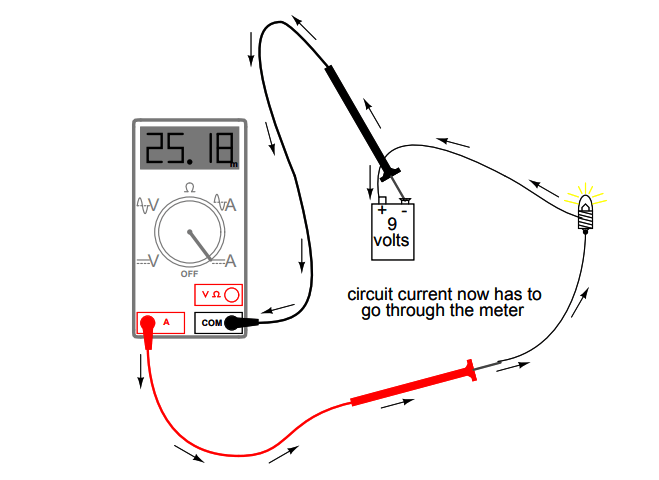
  3. Cut the circuit:
    • In the circuit whose current you want to measure, cut a wire in the circuit.
  4. Connecting the multimeter to the circuit:
    • Connect the multimeter probes to the wire that was cut in the circuit.
    • The multimeter must be connected in series with the circuit (by placing the multimeter between the two cut parts of the wire).
  5. Ampere reading:
    • Read the value displayed on the multimeter screen.
    • The displayed value should be the current electricity current in the circuit.

NB:

  • The multimeter must not be connected directly across the circuit without cutting and disconnecting the wire, otherwise damage to the multimeter may result.

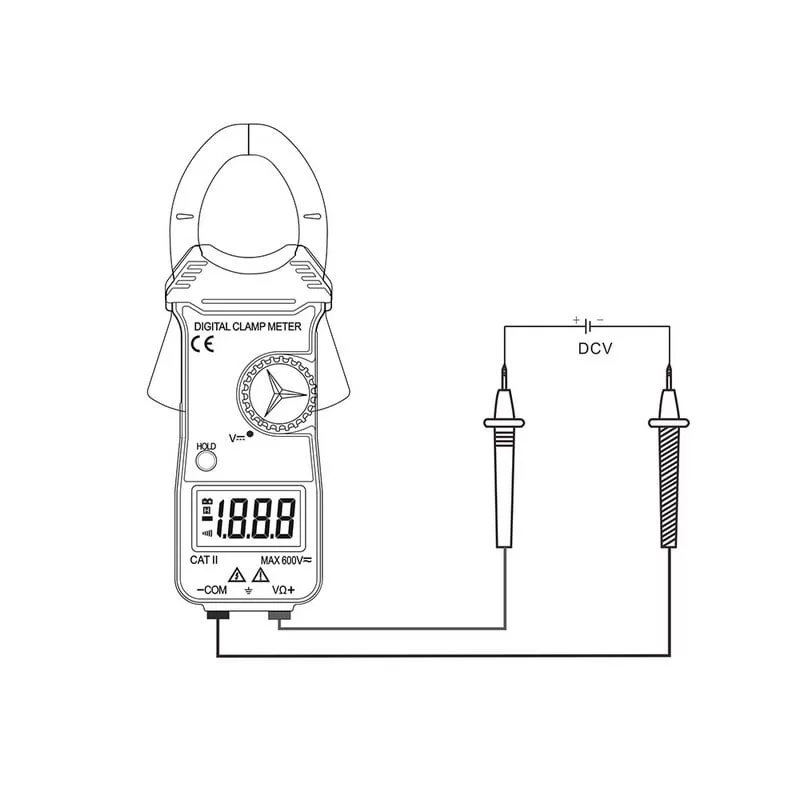
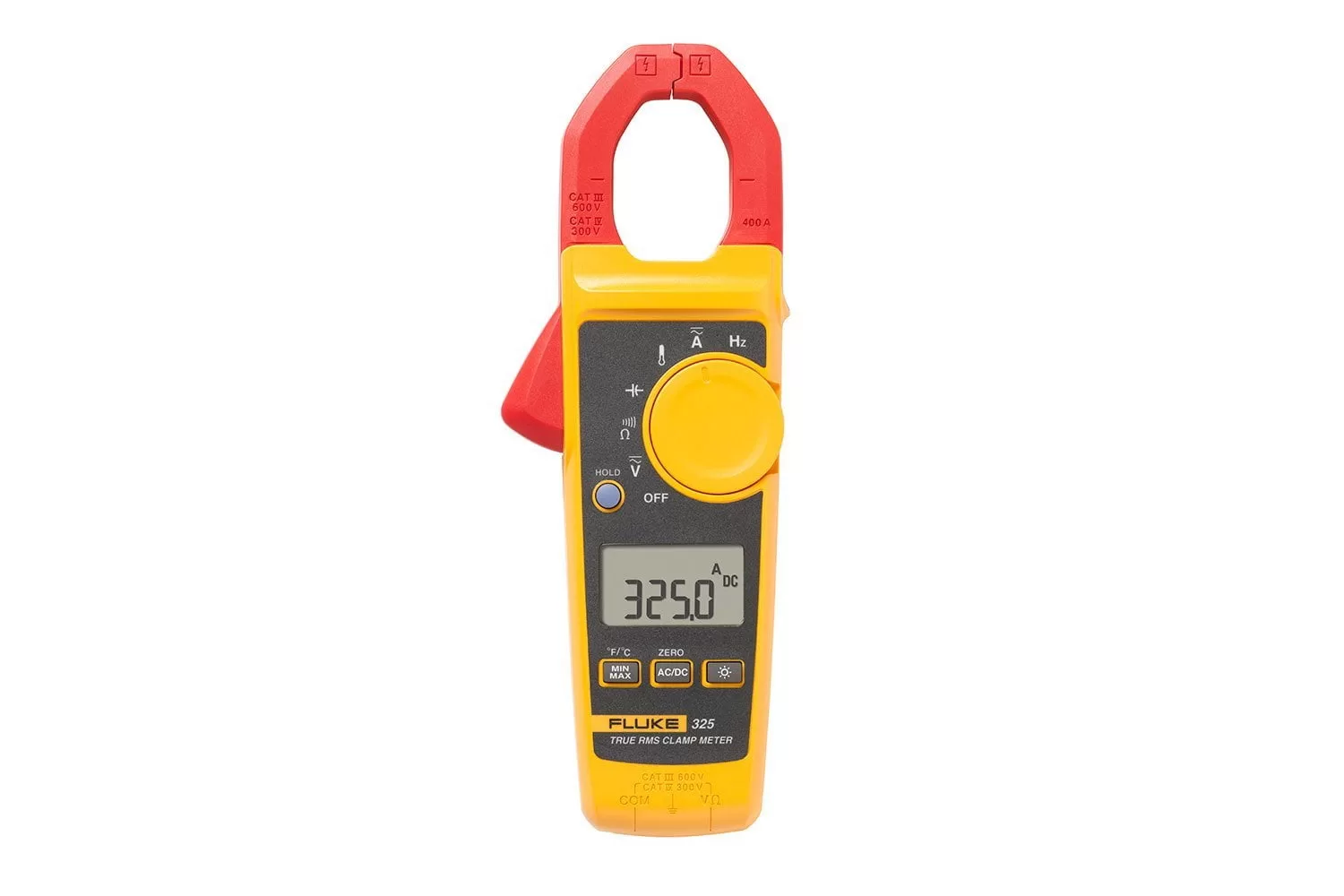
Using the clamp meter:

  • In some cases, a clamp meter can be used to measure current without disconnecting the circuit.

Safety note:

  • Always be sure to follow safety procedures when dealing with electrical current.
  • Avoid touching exposed parts to avoid electric shocks.

conclusion:

  • By using a multimeter correctly, you can easily and accurately measure the electrical current in your electrical circuits.

Everything you need to know about amperes and measuring electrical voltage

Thanks for your explanation of electrical circuits. Here are some additions and clarifications:

Series circuit for resistors:

Calculating total resistance: In a series circuit, the current is constant across all resistors, so the resistances are directly summed to obtain the equivalent resistance.

key= 1+ 2+ 3+…

Finding the value of resistance using Ohm’s law:If we know the value of the current< a i=4> and the total voltage� In a series circuit, we can use Ohm’s law to calculate the total resistance:

key=

Parallel circuits for resistors:

Calculating Total Resistance: In parallel circuits, the voltage across all resistors is the same, but the current branches across the resistors. The total resistance is calculated by reducing the product of these resistances by the inverse of their total conductance.

1 key=1 1+1 2+1 3+…

Finding the value of resistance using Ohm’s law:If we know the value of the current< a i=4> and the total voltage� In parallel circuits, we can use Ohm’s law to calculate the total resistance:

key=

Example:

In a parallel circuit containing a resistorand a resistor and resistance We can calculate the total resistance using the parallelism law:

1 key=13+16+19

AccountTotal

I hope this information is useful to you.

Everything you need to know about amperes and measuring electrical voltage

Thank you for explaining the law of electric potential difference. Here are some additional clarifications:

Electrical voltage:

Definition: Electric potential is a driving force that drives electrical charges to move in an electric circuit. It is measured in volts.

Mathematical expression: Electric potential () It can be expressed mathematically using the following relationship:

�=�/�

where:

  • is the electrical voltage.
  • is usable work.
  • is the electric charge.

Law of electric potential difference:

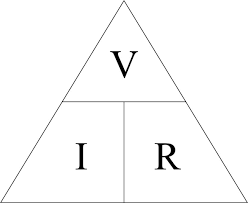
Definition: The law of electric potential difference says that the electric potential between two points in an electrical circuit is directly proportional to the current passing through the resistance between those two points, and inversely proportional to the conductive resistance between them.

Mathematical expression: �=�⋅�

where:

  • is the electrical voltage in volts.
  • is the electric current in amperes.
  • is the resistance in ohms.

Example:

We have a light bulb whose resistance5 Ω and it passes It has a current of2 �. We can use the law of potential difference to calculate the voltage across the lamp.

�=�⋅�

�=(2 �)⋅(5 Ω)=10 �

If the answer is10 �, It is the voltage that must be applied to the lamp for it to function properly.

I hope this was clear and helpful!

If you have any inquiry, please contact us freely and we will be happy to serve you.

Joyce box outside, 2 holes in frame, specific sizes

Gahzly website for purchasing electrical appliances

When we say Gahzly website, we are talking about one of the most famous Arab websites that was able, in a very short period of time, to achieve a very large demand for purchases from it by people from various parts and sectors of the Arab world.

On the Gahzly website, you will find a joint look and all the products that you may need in your home, starting with those for kitchens or bathrooms, but even those for gardens, you will find them on this wonderful site.

So, if you were lost before and did not know where to go to buy your products on the Internet, now you have the perfect solution, and all you have to do is go to the Gahzly website and start choosing the products you want.

LED strip connectionWhat are the features of Gahzly ?

Since we are talking about a site that is preferred by many people around the world, there is no doubt that it is a site full of various features and characteristics. Therefore, we have decided to devote our next paragraph to pointing out the most prominent features of the Gahzly site.

One of the most prominent features of the site is the proportionality of prices. On the Gahzly website, you do not have to worry about the imaginary prices of the products, as is the case with most sites that display their products on the Internet.

The price of delivering products is very reasonable and not expensive, and the site accepts delivery to various countries, without forgetting that it accepts free shipping on some products.

One of the features of the site is also the high quality of its products, as it is impossible to find a poor quality product. Rather, the Gahzly website deals with the major companies, Philips, for example, and other famous brands, so you must remove from your mind the idea of ​​the poor quality of one of the products. Another advantage of the site is that it does not specialize in one type of product, but rather you will find various types of products on it, for example, electrical appliances, hand tools, mechanical devices, paints, packages for establishing apartments, and many other types.

Gahzly website also accepts what is known as the shopping cart, which makes it easy for you to filter the products you want to buy and put them in one package in order to be able to pay with the click of a single button.

Accepts multiple payment methods.

Electrical circuit components

We are pleased that you visit our social media pages, where we publish exclusive offers on our website.

Our Facebook page Here.

Our Twitter account Here.
Leave a Reply