sell online January 15, 2024 11 min read

How to measure grounding resistance

How to measure grounding resistance Grounding resistance is vital in the field of electricity, playing a crucial role in ensuring the safety of personnel and equipment. Measuring ground resistance is a necessary procedure to check the efficiency of electrical systems and ensure…

How to measure grounding resistance

How to measure grounding resistance

How to measure grounding resistance

Grounding resistance is vital in the field of electricity, playing a crucial role in ensuring the safety of personnel and equipment. Measuring ground resistance is a necessary procedure to check the efficiency of electrical systems and ensure that the connection between the system and the ground is made correctly. In this article, we will take a look at how to measure grounding resistance and its importance in keeping the environment and individuals safe.

The importance of measuring grounding resistance:

  1. Ensuring the Safety of Personnel: Measuring grounding resistance is an essential part of electrical safety procedures, as it helps determine whether the ground is capable of effectively discharging excess electrical currents, reducing the risk of Exposure to electric shock.
  2. Equipment Protection: The grounding resistance measurement measures the effectiveness of the connection between the electrical system and the ground, thus protecting the equipment from damage resulting from excessive currents and ensuring its efficient operation.
  3. Standards Compliance: Most electrical standards and regulations require grounding resistance measurement as part of regular maintenance of electrical systems, to ensure compliance with industry and safety standards.

How to measure grounding resistance:

Earthing resistance is measured using a device known as an “earth resistance meter.” Or “ohm meter”. The main steps to measure grounding resistance include:

  1. Site Preparation: This step involves ensuring that the ground is well connected and free of obstructions. Sites designated for grounding measurement must be cleaned of dust and dirt.
  2. Connecting the terminals:The technician connects the terminals of the grounding resistance measuring device to the ground and the electrical system to be examined.
  3. Resistance measurement: The device is turned on and the grounding resistance between the system and the ground is measured. The grounding resistance is specified in “ohms”, and the value displayed on the device screen is read.
  4. Compliance verification:The measured value is compared to the values ​​specified in industry standards and local regulations to ensure compliance.
Calculating grounding resistance using the voltage drop method:

The fall-of-potential method is one of the main methods used to measure grounding resistance. The measurement is made using an Earth tester, and the test is performed before connecting the electrical service to the consumer. The process includes the following:

  1. Determining measurement points: The reference electrode whose resistance will be measured is selected, and two auxiliary electrodes are buried at a depth ranging from 30 to 60 cm in the soil. One electrode is used to measure current C, and the other to measure voltage P.
  2. Connecting the device: The earth resistance measuring device is connected to the reference electrode and two auxiliary electrodes. The device is set to measure using a voltage drop method.
  3. Generate a test current:The device generates a test current (C) flowing through the ground and the voltage drop between the reference electrode and the auxiliary electrode (P) is measured.
  4. Voltage and Current Measurement: The voltage (P) generated by the test current and the current (C) passing through the ground are measured. Both readings are recorded.
  5. Calculating grounding resistance:The grounding resistance is calculated using the relationship: �=�� where is the current Test. is the voltage drop (P voltage), and is the grounding resistance,
  6. Analysis of readings: Compares the calculated grounding resistance value with accepted values ​​and industry standards to ensure compliance and system safety.

This method is considered reliable and effective for estimating grounding resistance, and contributes to ensuring the safety of electrical systems and their users.

How to measure grounding resistance

Measuring grounding resistance using Ohm’s law:

The voltage drop method is used to measure grounding resistance, whereby an alternating currentis passed through the external electrode, at a midpoint between them. The device follows Ohm’s law to calculate ground resistance. /span>, and the voltage is measured across an internal electrode

Measurement steps:

  1. Clarification of the two situations:
    • The current electrodeis placed at a distance of 30-50 meters from the grounding electrode.
    • The voltage electrodeis placed halfway between the grounding electrode and the current electrode< a i=4>�.
  2. Ground measurement:
    • The device measures the voltage and current between and Ohm’s law is used to calculate the initial ground resistance.
  3. Moving electrode potential:
    • The potential electrode is moved 5 meters from its original position.
    • The device measures the voltage and current again.
  4. Moving in the other direction:
    • The potential electrode is moved a distance of 5 meters to the other direction.
    • The device measures the voltage and current again.
  5. Analyze measurements:
    • If the measurements agree and are within acceptable limits, the average is calculated.
  6. Calculate the ultimate resistance:
    • The average is calculated using the relationship: �=�� where is the grounding resistance, is the voltage, and < /span> is the current.

Repeating these operations helps in obtaining an accurate value for the grounding resistance, taking into account acceptable limits and ensuring the safety of the electrical system.

Improve the accuracy of grounding resistance measurement:

If the values ​​are more than 30% away from the previous reading, it is preferable to increase the distance between the original electrode and the auxiliary electrodes. This is done to obtain an accurate measurement of grounding resistance.

If more than one electrode is connected (in parallel), the device measurement represents the total resistance of the multi-electrode grounding system.

The following table shows the distance between the grounding electrode and both the voltage and current electrodes, depending on the length of the grounding electrode:

Electrode depth(m)Potential electrode distance (m)Current electrode distance (m)
21525
32030
62540
103050

Tips for getting an accurate measurement:

  • The interference of the current electrode and the ground electrode in each other’s field must be avoided.
  • It is preferable that the voltage electrode be between the two fields and not overlap in the field of the other.

These procedures take into account the ambient conditions and are of great importance to ensure that the grounding resistance is measured accurately and that electrical safety is achieved.

Ensure accurate grounding resistance measurement:

It is recommended that measurements be made to check the position of the electrodes to ensure an accurate measurement is achieved. It is recommended to choose a site for examination and make three measurements: the first at the selected location, and the remaining two as follows:

  1. The potential electrode (P) is moved 10% away from its original location.
  2. The voltage electrode is moved 10% closer to its original location.

If the value of these two additional measurements agrees with the original measurement, within the required level of accuracy, the reading is considered correct, and the grounding resistance can be calculated by taking the average of the three results.

If any of these three values ​​differ significantly, it is possible that the test electrodes are incorrectly positioned, either too close to the grounding system being tested, too close to each other, or too close to other structures, causing interference and resulting in To an error in the results. In this case, it is recommended to reposition the electrodes at a greater distance or in a different direction and repeat the three measurements. This process must be repeated until a correct result is obtained.

Additional Tips:

  • The electrodes should be on one straight line.
  • It is best to avoid overlapping electrodes in each other’s field and repeat the checks to ensure accuracy.
  • It is advisable to pay attention to the soil uniformity of the ground where the measurements are made.

Recommended grounding resistance values:

  1. For large, commercial and industrial installations:
    • Recommended grounding resistance usually ranges between 1-5 ohms.
    • If there is soil with high specific resistivity, obtaining a low resistivity can be a challenge, and may require the use of a large number of ground electrodes, resulting in high cost.
  2. For light current systems in buildings:
    • It is preferable to use a grounding system with a resistance of no more than 0.5 ohms.
    • In hospitals, medical equipment is required to be grounded using a separate grounding system and with a ground resistance of less than 0.5 ohms.
  3. For power substations and communication towers:
    • A grounding resistance of 0.5 to 1 ohm can be used.
  4. For lightning protection systems:
    • The grounding resistance should preferably be less than 10 ohms.

Additional notes:

  • Grounding resistance values ​​depend on the magnitude of the expected short-circuit current, and the larger this current is, the lower the required resistance value.
  • More than one grounding electrode can be used in parallel to achieve low grounding resistance values.
  • The grounding resistors must be oriented and not interfere with each other or with other structures.
  • They can require special requirements for grounding medical systems in hospitals.

Note: It is recommended to coordinate with a qualified electrical engineer to ensure that the grounding system is properly designed and implemented in accordance with local and international standards and regulations.

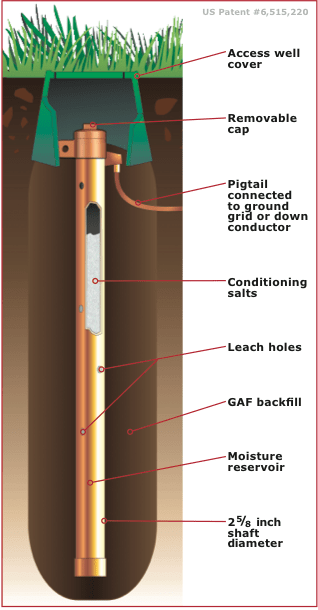
Ways to reduce ground resistance:

  1. Chemical treatment of soil:
    • They include the use of chemicals such as magnesium sulphate or copper sulphate.
    • Sodium chloride (salt) mixed with charcoal or magnesium sulphate are popular options, as they have low cost and good electrical effect.
  2. Use additional ground rods (Spikes):
    • The ground resistance can be reduced by using several bars in parallel.
    • A second rod reduces ground resistance by 60%.
    • A third rod reduces ground resistance by 40%.
    • A fourth rod reduces ground resistance by 33%.
    • The distribution of triangle-shaped bars can be optimized to achieve better effect.
  3. Stitch the bars at a greater depth:
    • The grounding effect is improved when the rods are embedded deeper into the soil.
  4. Increasing the length of the grounding electrode:
    • Increasing the rod length can reduce the ground resistance.
  5. Increasing the diameter of the grounding rod:
    • Increasing the rod diameter can improve the ground resistance reduction effect.

Improving the grounding of electrical systems requires careful analysis and specialized design that includes many influencing factors such as soil type and environmental conditions. It is preferable to work with an electrical engineer to ensure the best performance of the grounding system.

Measuring the specific resistance of soil:

The specific soil resistivity is measured using four electrodes, and the steps are as follows:

  1. GPS:
    • Choose sites to plant the electrodes in the soil in a straight line.
    • It is preferable that the distance between the electrodes be about 30 meters, and not less than 20 times the length of the electrode.
  2. Electrode arrangement:
    • Plant four electrodes evenly spaced in the soil.
  3. Use the equation:
    • The following equation is used to calculate the specific resistance (ρ):�=2×�×�×�

    where:

    • is the specific resistance of the soil (ohm.cm).
    • is the distance between the electrodes in centimeters.
    • π is an approximate constant number equivalent to 3.14.
    • is the soil resistance in ohms.
  4. Measurement and analysis:
    • Soil resistance () is measured by a resistivity measuring device.
    • The results are used in the equation to calculate the specific resistance.

It is noted that this process is part of soil and land studies, and may be carried out with the participation of engineers or geoscientists.

If you have any inquiry, please contact us freely and we will be happy to serve you.

How to measure grounding resistance

Gahzly website for purchasing electrical appliances

When we say Gahzly website, we are talking about one of the most famous Arab websites that was able, in a very short period of time, to achieve a very large demand for purchases from it by people from various parts and sectors of the Arab world.

On the Gahzly website, you will find a joint look and all the products that you may need in your home, starting with those for kitchens or bathrooms, but even those for gardens, you will find them on this wonderful site.

So, if you were lost before and did not know where to go to buy your products on the Internet, now you have the perfect solution, and all you have to do is go to the Gahzly website and start choosing the products you want.

How to measure grounding resistanceWhat are the features of Gahzly?

Since we are talking about a site that is preferred by many people around the world, there is no doubt that it is a site full of various features and characteristics. Therefore, we have decided to devote our next paragraph to pointing out the most prominent features of the Gahzly site.

One of the most prominent features of the site is the proportionality of prices. On the Gahzly website, you do not have to worry about the imaginary prices of the products, as is the case with most sites that display their products on the Internet.

The price of delivering products is very reasonable and not expensive, and the site accepts delivery to various countries, without forgetting that it accepts free shipping on some products.

One of the features of the site is also the high quality of its products, as it is impossible to find a poor quality product. Rather, the Gahzly website deals with the major companies, Philips, for example, and other famous brands, so you must remove from your mind the idea of ​​the poor quality of one of the products. Another advantage of the site is that it does not specialize in one type of product, but rather you will find various types of products on it, for example, electrical appliances, hand tools, mechanical devices, paints, packages for establishing apartments, and many other types.

Gahzly website also accepts what is known as the shopping cart, which makes it easy for you to filter the products you want to buy and put them in one package in order to be able to pay with the click of a single button.

Accepts multiple payment methods.

How to measure grounding resistance

We are pleased that you visit our social media pages, where we publish exclusive offers on our website.

Our Facebook page Here.

Our Twitter account Here.

Leave a Reply